
Suspended solid
K8700 Digital Suspended Solids/Sludge Concentration Sensor
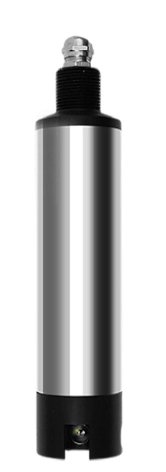
The K8700 Suspended Solids (Sludge Concentration) Sensor is based on infrared scattered light technology. Specifically, when the infrared light emitted by the light source passes through the sample to be tested during transmission, it scatters - and the intensity of this scattered light is proportional to the suspended solids concentration. The sensor is equipped with a scattered light receiver at a 90° or 180° angle, and derives the suspended solids concentration value by analyzing the intensity of this set of scattered light. Its main body is made of stainless steel, featuring a wide linear measurement range, high accuracy, and long durability.
| Measurement Range | 0~200 mg/L; 0~5000 mg/L; 0~50000 mg/L |
|---|---|
| Measurement Accuracy | <10% of the measured value (depending on sludge homogeneity) or 10 mg/L, whichever is larger |
| Temperature Range | 0~45 °C |
| Pressure Resistance Range | 0~3 Bar |
| Response Time | 65 < T90 < 300 s (adjustable via settings) |
| Calibration Method | Standard Solution Calibration, Water Sample Calibration |
| Mounting Thread | NPT 3/4 |
| Housing Material | Stainless Steel + POM |
| Weight | 1.2 kg |
| Length | 200 mm |
| Cable Connection | Integrated Direct Connection Type |
| Power Supply | 9-36 VDC |
| Communication Method | MODBUS RTU Protocol via RS485 |
Features Overview
- Imported optical lenses, featuring excellent corrosion and wear resistance as well as high light transmittance
- Imported LED light source with stable light intensity and long service life
- Stable and reliable photoelectric weak signal processing technology, plus innovative high-order nonlinear fitting algorithm
- IP68 waterproof rating
- NPT 3/4 thread enables direct installation into the process
Expansion Capability
- The cable length can be extended up to a maximum of 100 m
Applications
- Sewage Treatment Plants
- Water Supply Plants
- Water Stations
- Surface Water
- Aquaculture Industry
- Industrial Processes
K-TU3000 Turbidity/Sludge Concentration Transmitter
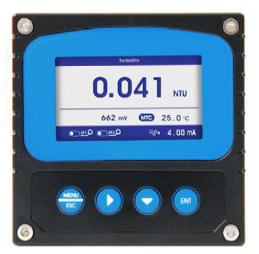
The K-TU3000 Turbidity/Sludge Concentration Transmitter adopts a miniaturized design. It integrates measurement and display, signal transmission, alarm, and communication functions, flexibly meeting the monitoring needs for various online turbidity/sludge concentration values. Equipped with a high-definition color LCD screen and an intelligent operation menu, it provides users with simple and user-friendly operation, and can adapt to the harsh requirements of various on-site working conditions.
| Screen Parameters | 2.8-inch high-definition color screen (320*240) |
|---|---|
| Measurement Range | 0.001-99999 NTU |
| Resolution | 0.001; 0.01; 0.1; 1 |
| Basic Error | ±1% F.S (Full Scale) |
| Temperature Compensation Range | 0~60 °C |
| Temperature Compensation | Automatic or manual |
| Electrode Residual Signal | 1% |
| Communication Output | RS485 Modbus RTU (read-write two-way communication) |
| Stability | Under normal pressure and constant temperature, weekly drift <2% F.S |
| Current Output | Two channels of 4~20 mA (load resistance <750 Ω) |
| Two Groups of Relay Control Contacts | 3A 250VAC, 3A 30VDC |
| Instrument Installation Method | Panel-mounted / Pipeline-mounted / Wall-mounted |
| Instrument Dimensions | (H × W × D) 98 × 98 × 130 mm |
| Mounting Hole Dimensions | 92.5 × 92.5 mm |
| Response Time (90% of final value) | <60 s at 25°C; <30 s at 35°C |
| Overall Protection Rating | IP65 |
| Instrument Power Supply (Optional) | 85~265 VAC or 9~36 VDC, Power <3W |
| Instrument Operating Environment | Ambient temperature: -10~60 °C; Relative humidity: not more than 90% |
Features Overview
- Intelligent menu design, enabling easy and convenient operation
- LCD color display for an elegant and clear interface
- Globally universal power supply (85~265VAC); customizable DC version (9-36VDC) is also available
- Multiple automatic calibration functions
Applications
- Tap Water Supply
- Secondary Water Supply
- Swimming Pools Matching with Chemical Dosing Equipment
- Industrial Processes
- Wastewater Treatment